write good sentences.
a hill i will die on.
i was recording a podcast recently (i don’t know if i’m allowed to talk about it yet, so for now it’s a secret but just know it’s a banger with some of my favorite people and we’re talking about my favorite thing!) and the moderator asked us a few quick burst questions at the end (a format that i love and more folks should do it). one of them was,
what’s a craft hill that you would die on?
or maybe it was what’s a writing hill you would die on, or something like that, but it amounted to the same thing for me.
and, you know, when you get asked these questions on the spot, there’s a sort of recency bias and all you can think of—if you can think of anything—is the most recent thought you had and not the truest deepest held opinion that you might respond with if given adequate time.
in this instance, i guess the thing that i’d been thinking about was sentences.
recently, i’ve read some books with great sentences and some books with less than great sentences. some books that were still entertaining but could have been better with better sentences. some books that were okay but got elevated higher by good sentences.
and i’ve been thinking about the sentences in my own work, and how the attention that i pay them changes based on the length of the work (aka how much text i have to edit and how much time to edit in), and how much i love the play of syntax and how it conveys meaning.
the hill that i will die on: everyone who wants to be a good writer needs to learn sentences. they need to learn how to use punctuation and grammar to create a wide variety of sentences. that means learning the rules of commas and colons and semicolons. it might even mean learning what a predicate is.
well, golly, cherae, how colonial, as a matter of fact i want to disrespect the english language so bad that i don’t care about grammar and i don’t want to sound like some stilted victorian, i want to sound like myself and i want to sound real.
everyone who wants to be a good writer needs to learn sentences.
yah, yep, yop. that’s cool, and i get it. but the thing is—there is a grammar to the way we speak. there’s a grammar to the way our slang and our in-group speak works—just listen to a white person (not Eminem) try to speak Black American vernacular and you’ll understand. and knowing the rules of the written language will help you better show your natural voice on the page. knowing the rules will help you break them without your audience losing the thread. (read anything by kai ashante wilson and you will, i think, understand.)
careful use of punctuation and sentence structure convey meaning. they convey emotion and tone. (just think of how everyone gets distraught by the addition or lack of a period/full stop in a text message—and now you think that person hates you.) depicting everything from stream of consciousness to dialect to character/narrator personality—that’s syntax, baby. that’s punctuation. a writer can use it to change the mood of a scene, or keep you from falling asleep of boredom, or stun you with the beauty of a well turned phrase.
and once you know it, you can choose when and how to deploy it. not every work needs the same sort of sentences. you may prefer a more workmanlike prose style, spare, simple sentences. that’s grand. that’s hot. but the better you understand the tools, the more effective those sentences will be. you’ll make your work less repetitive and more engaging, while also understanding how to make it invisible so the reader can focus on the story.
and if you’re a purple prose person, you really need this. because writing pretty prose can trip you up like none other if you can’t also bring the reader along with you, and the best way to do that is to use the guideposts that language gives us—punctuation. Not to mention, if you can wield a complex multi-clause sentence, your work will sound more elegant, which is usually the goal for writers who paint with the purple pen.
okay, that’s my screed. tl;dr: learn grammar and punctuation so that you become a more robust writer. if you want to study sentences or you’re a nerd like me and got off on grammar classes in school, check out these books:
 Harper Perennial
Ursula K. LeGuin with my perennial favorite craft book, especially for the nuts and bolts. i use the exercises within like a musician uses scales. actionable, easy to understand, and has examples to demonstrate the effects of the techniques.
 Virginia Tufte310 Pages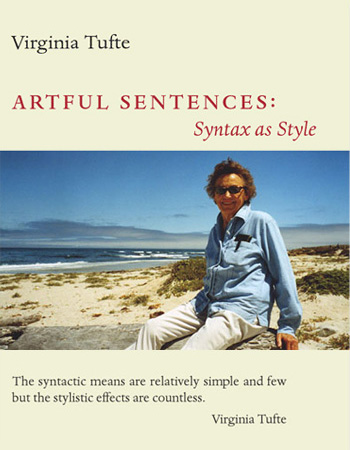
Syntax as Style is basically a look-book for sexy sentences. see how others have done it, and experiment to make your own. the many models are divided into grammatical types of sentence from simple to complex, so you’ll learn a few terms as well. i learned about this from Matt Bell’s Refuse to be Done, which i’ve also recommended many times. i am always trying to write better sentences, and this book shows me how you can really flex.
now that i’ve subjected you to mine, what craft/writing hill would YOU die on, as a reader or a writer?
Thanks for reading. If you like these ad-free, AI-less posts, please consider supporting my work by becoming a paid subscriber, dropping a tip in the tip jar, or buying a book for a friend.