Running Doesn’t Suck
Some training tips for getting into the sport so that it’s enjoyable, and only as hard as it’s supposed to be.
Howdy, friends. This is the latest in my mini-series about getting muscles like me (cough or Touraine).
Running doesn’t suck, you’re just doing it wrong. Trust me, I know. I used to do it wrong. I will always recommend starting to run with Coach Bennett on the Nike Run Club app. Start with “First Run.” Then go to “Next Run.” Simple as that. He’ll teach you everything you need to know.
Now that we’ve hit the big one, let’s bust some more running myths. (For clarity, most of this post, I’m talking about steady running, working your way up to 1 mile, 5k, and beyond. Sprinting absolutely has it’s place, but it’s not always the best starting point for someone who already thinks running sucks. Unless you think sprinting is fun—in which case, godspeed, brother.)
The first thing you’re probably doing wrong? Your head game. You’re coming in with the wrong attitude.
- “But Cherae! I hate running and I’ll always hate running!” If that kind of rigidity is working for you in your life, you do you. This isn’t for you. Then again, maybe it could be. Either way, not up to me. You know where the x button is.
- “But Cherae! I am disabled/injured/have other genuine medical reasons not to run!” If you have a genuine medical issue stopping you, this isn’t for you, either. Not right now, anyway. Take care of yourself first. But also, ask yourself how much this has to stop you—for example, I know loads of runners with asthma; they just have to make certain accommodations. You can look up that kind of thing, but it’s not my area so I won’t make any pronouncements. Bad knee? See if there are certain kinds of strengthening exercises that can help in parallel with running. Other general aches and pains? Scale back with a slower pace or a run/walk strategy—or, counterintuitively, speed up a little to find a more natural running gait—or a try a more forgiving surface (e.g. track/earth vs. concrete).
- “But C. L.! Running will kill my gains!” No it won’t. There are approximately one million “hybrid athletes” (aka: athletes) who are managing just fine, me included.
- You don’t need to walk uphill on a treadmill instead, though you CAN do that and in fact if running is hard, walking uphill is great. Walking is great period, for everyone of all abilities and it’s one of the best things you can do for your body and mind.
- What running will do is help your endurance in your lifts, helping you use energy more efficiently. However, depending on how much you want to run, you may need to accommodate more recovery into your schedule.
- You can do it in the same workout, though it will make one feel like it is harder than the one that came before it. I like to do easy runs after my lifting because it helps shake out some of the acid, and loosens things up; mind you, these are easy runs. Not speed runs or hill runs, etc. If you are training for a particular event/performance, however, you should prioritize that workout first while your freshest. Racing? Run first. Strength competition? Lift first. If you have the time, though, separate the workouts by a span of hours (e.g. run in the morning, lift in the evening). They’ll both be stronger.
- “But Cherae! Running is BORING.” Maybe so. If you’re boring. There’s so much you can do on a run.
- Listen to audiobooks and podcasts (see below for links). I’ve learned so much on runs; it’s especially great because you have nothing to do but think about what you’ve just heard. Often, if I hear something interesting or thought provoking on a nonfiction book or podcast, I’ll pause it and just run with that for a while.
- Especially books about running and other runners. They can be really inspiring. Running my little 5 mi runs while listening to someone who ran Badwater or UTMB makes me feel like I am just as badass as they are. And honestly, I kinda am. It’s not THAT different, lol.
- There are ~500 hours of podcast play for each Critical Role campaign. Just saying.
- Run with friends. If you’re a sociable type, or your misery just loves a little company, rope your friends into it. You, too, can become a running proselytizer. Or, find a local run club—there are general ones and ones for various affinity groups, and you can find the one that makes you feel most welcome.
- Switch up the pace and the distance (within your capacity). Always running slow and steady? Go out one day and do little bursts of speed. Always gunning it? Slow it down and take in the scenery. Mix things up, regularly.
- Think about your life choices. It’s a good time to get right with yourself.
- Listen to audiobooks and podcasts (see below for links). I’ve learned so much on runs; it’s especially great because you have nothing to do but think about what you’ve just heard. Often, if I hear something interesting or thought provoking on a nonfiction book or podcast, I’ll pause it and just run with that for a while.
- “But Cherae! Running is too hard!” Maybe so. It is supposed to be a little hard, at least sometimes. At least, if you’re trying to make improvements in fitness. You have to go a little beyond yourself. It shouldn’t be torture, though.
- Don’t go so hard. Now that we’re adults out of PE class, no one is here to shout at you to go faster. No one who matters cares how fast you go. Start slow, slower than you need to—at the beginning of a single run, but also at the beginning of your running journey. It’ll build in some longevity.
- Be proud of yourself for doing hard things. You’re building resilience, which, in my humble opinion, is a dying attribute.
- “But C. L.! People will judge me for running slow/not looking like a runner!” Yeah, that can be a challenge to get around, but that is something that’s mostly in your head. People probably will not give two shits about you, honestly, and if they think you’re running slow or that you’re too chubby, eh, well. They may! But you can’t control that and why should you stop your life for them?
- This is one reason, though, that I don’t post things on running social media, like Strava, or keep it private to my own immediate friends. Comparison in running, as with writing, is the death of joy. It’s one thing to be inspired by others, but one more social media platform is the last thing I needed. Like all social media, even though the intent behind it was to create bonds and perhaps a little good-natured competition, that’s not how it’s grown to be used. To avoid getting weird comments or feeling ashamed of what should actually be a moment of pride, I don’t share any times on any social media. It’s not worth it. I know folks who feel the same way about their lifts. There’s just too much assholery out there, and frankly, the whole world doesn’t need access to every facet of my life.
Okay, myths busted. How should you get started?
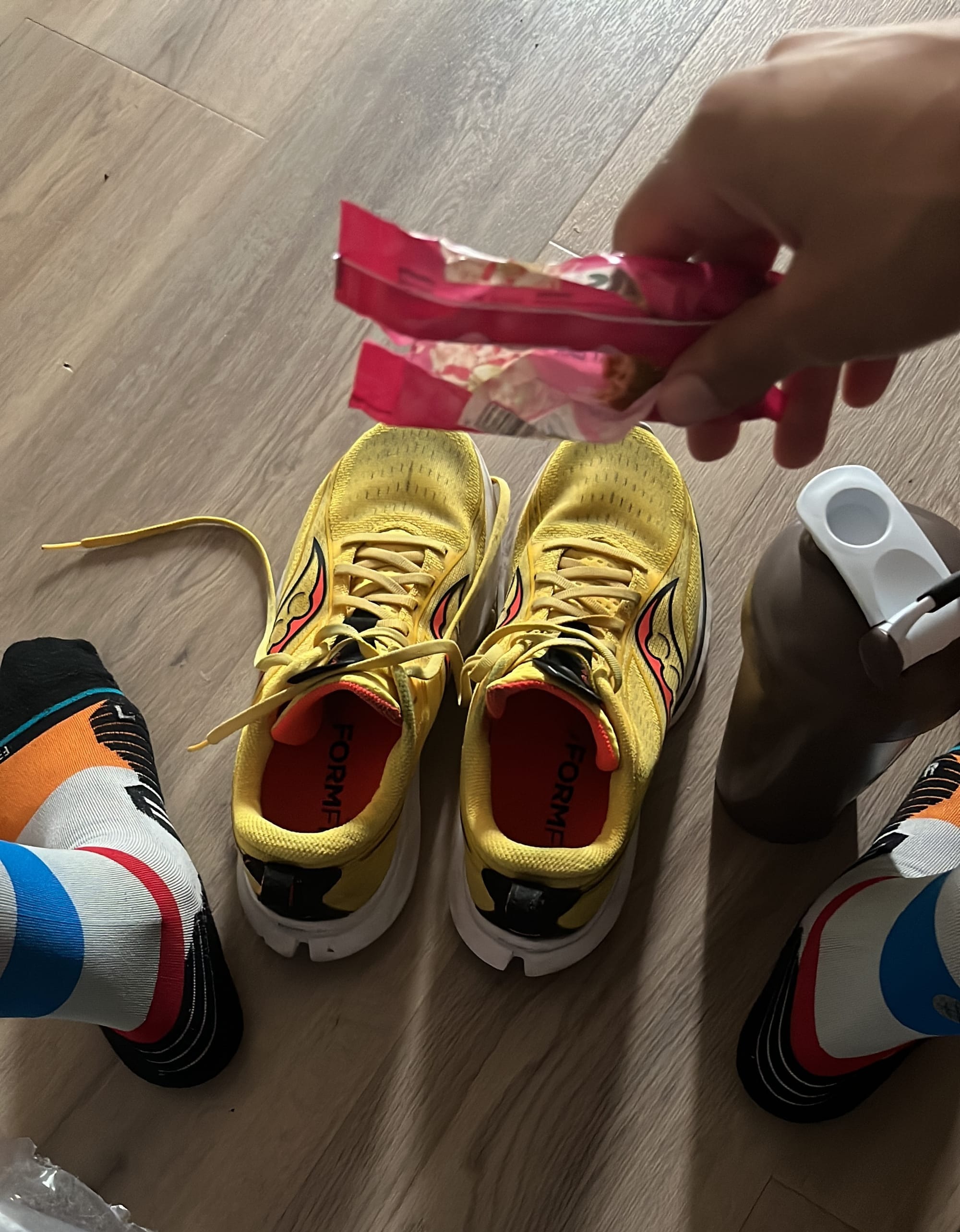
- You can just go. Lace up. Go run for a few minutes, down the road or around the block. Keep it easy. Turn around when you want. Leave something in the tank. Do it again a day or two later. Keep testing how far you feel like you can go, and increase gradually.
- You can start with a plan. If you need a bit more structure when you’re starting something you’ve never done, look up a beginner plan. Set a target that makes sense for where you are. (If you’re coming from a sedentary background, a marathon may not be the best place to start, unless you have a very very long on-ramp program.) Garmin watches have some good ones available that adapt to you, as well as Runna, a popular one. You can also start with the tried and true Couch to 5k. Hal Higdon also has a beginner runners program. The Nike Run Club app also has a 4 week plan for beginners, and by now I’m sure you know what I think of Coach Bennett’s coaching. He’ll teach you a lot of what you need to start. See what plan looks like something you can take on. Experiment. If it’s too hard, change gears. Work your way up. (See more resources below.)
- Ramp up your miles/time on feet slowly. Also slower than you think you need to. (Are you noticing a trend here?)
- It can help to put a race in the calendar to hold yourself accountable. It doesn’t have to be real. It can be an imaginary race that’s just you, maybe a few friends. Any sort of accountability will be good at the early stages of building the habit. Community helps, too. Even reddit and, yes, Strava, can be helpful if you can’t find something local.
- If you’re running as a means of fat loss, which many people do, that’s cool. That’s fine. Do be careful of using running as an ‘excuse’ to eat all the things you know you should eat less of. Think of your body as an engine that you more often than not need to put high quality food into. Most importantly, be careful of getting into spin cycles of trying to do more than you should because you think it will get you to your goal faster. It won’t. You’ll get hurt. You’ll hate the sport. Also, consider thinking about running not as a way to lose something, but a way to gain something. Yeah, I stole that from Coach B, too. But it’s a good one. An important one. Gain nutrient-rich food that fires you up and energizes your body. Gain the peace of mind of spending time alone, clearing your head. Gain time with a friend. Gain new friends at the running club. Gain new strength, new endurance, new skills. It will keep you feeling positive about the sport. It’ll keep you taking care of your body instead of overtraining and mentally spinning on a goal you can’t really control the pace of.
- In the immortal words of Coach Bennett, this is about running, and this is not about running. (Want more running/life/writing advice?)
Resources
I posted this before when I was talking about the Maverick Osprey Lakes 25k I was training for, but here they are again. Some internet folks who inspire me on the running front/good resources if you're interested in running or learning to run (obviously, you don’t need to follow everyone):
- Coach Bennett: My favorite, and imho, the best. Originally of Nike Run Club fame, he now has his own podcast and newsletter. He's the best motivator, the best teacher that I've had for this sport. He's gotten a nod in almost all of my acks--go ahead, check the back of The Unbroken.
- Nike Run Club (app): Specifically the guided runs, many of whom were led by...Coach Bennett. There's a great set of First __ runs, and those got me started on the right foot, and taught me how not to hate the sport with my bad attempts at starting it.
- Hal Higdon's Training Plans: Some great plans that tend to do a good job at keeping people from injury. He errs on the conservative side of mileage on the novice plans, which is great.
- Garmin Training Plans: Garmin watch's in-house half marathons training plans got me to the distance twice, and I like those, too. I've thought about going with one for this race, even, but I needed just a bit more flexibility.
- tommyrunpt/That's Runnable: Tommy is an ultrarunner I found on insta, and then started a podcast, as one does. I've listened to a couple and they seemed well-suited to helping new runners, though Coach Bennett is the one to go to for motivation. He's got a lot of great tips and experience, and shares a lot of the technical know-how. He also acknowledges that he's a bit silly for putting his phone down, running back, then running forward again, just to get the cool shot. I appreciate the honesty.
- Tommy Rivs: A different Tommy entirely, Tommy Rivs is also an ultrarunner who was already well known in the field, and developed a devastating cancer during the COVID era. Somehow, he lived. And I just love his ethos. My partner even got me a necklace with his motto: GENTLY RAGE.
- Jonny Davies: A bit more bro-y, he's known for performing wild ultra stunts, like running all the London tube lines. Very loveable, though, and he let's you peek into some of his training.
- The Morning Shakeout: Another favorite up there with Coach Bennett. A longstanding running podcast that interviews runners from all walks of life, all areas of the sport. Some are long, some are shorter, all are great, inspiring companions for a run. There's also a newsletter that pulls together other thoughts and news in the running/running philosophy world, and a weekly workout.
- The Half Marathoner: Pretty cheerful newsletter with a lot of community built in.
Thanks for reading. If you like these ad-free, AI-less posts, please consider supporting my work by becoming a paid subscriber, dropping a tip in the tip jar, or buying a book for a friend.